Image

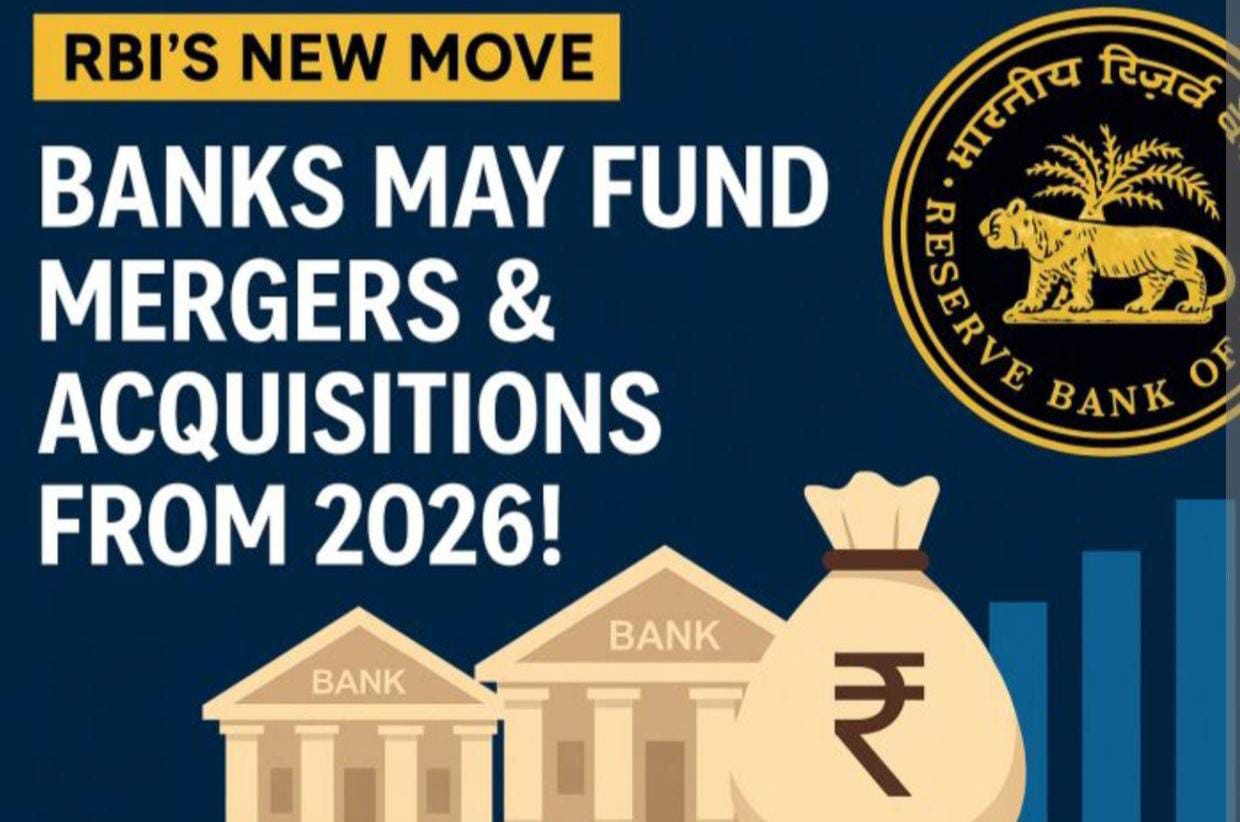
RBI’s Draft Framework Reshapes M&A Financing

  • 2025-11-21

RBI has released a draft framework allowing Indian banks to play a bigger role in acquisition finance — a space previously dominated by private credit funds. This marks a major shift in how M&A deals can be funded.


📌Key Points

• RBI has outlined clear rules for banks to provide acquisition finance, bringing formal structure to an area long driven by private credit.

• The framework clarifies risk eligibility, capital norms and regulatory oversight for banks entering buyout financing.

• Banks can now tap their balance sheets and lower cost of funds to support leveraged buyouts and acquisition-led deals.

• This move is expected to create a more competitive and transparent market for M&A debt financing.

✅Strategic Impact

• Greater bank involvement can lower borrowing costs and expand access to acquisition finance, potentially boosting deal activity.

• Private credit funds will still play a major role due to their flexibility, speed and higher risk appetite — leading to coexistence, not replacement.

• Strong risk management and governance standards will be essential as the market evolves.

🔅Bottom Line

RBI’s proposed rules open the door for bank-funded buyouts at scale, reshaping India’s M&A financing ecosystem — while private credit continues to remain an important pillar for innovative and customised deal structures.


Read More
Image

INCOME TAX-UPDATE

  • 2025-11-13

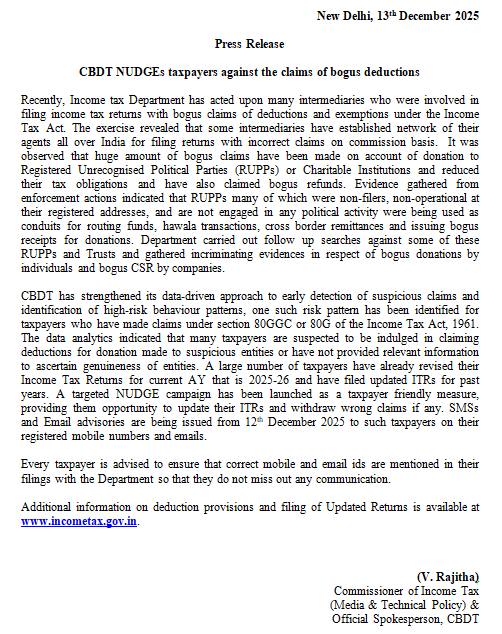
Saving tax with fake deductions is not planning, it’s postponing trouble.

Officially for taxpayers. Practically for Chartered Accountants  

Read More
Image

Supreme court of India record of proceedings

  • 2025-12-21


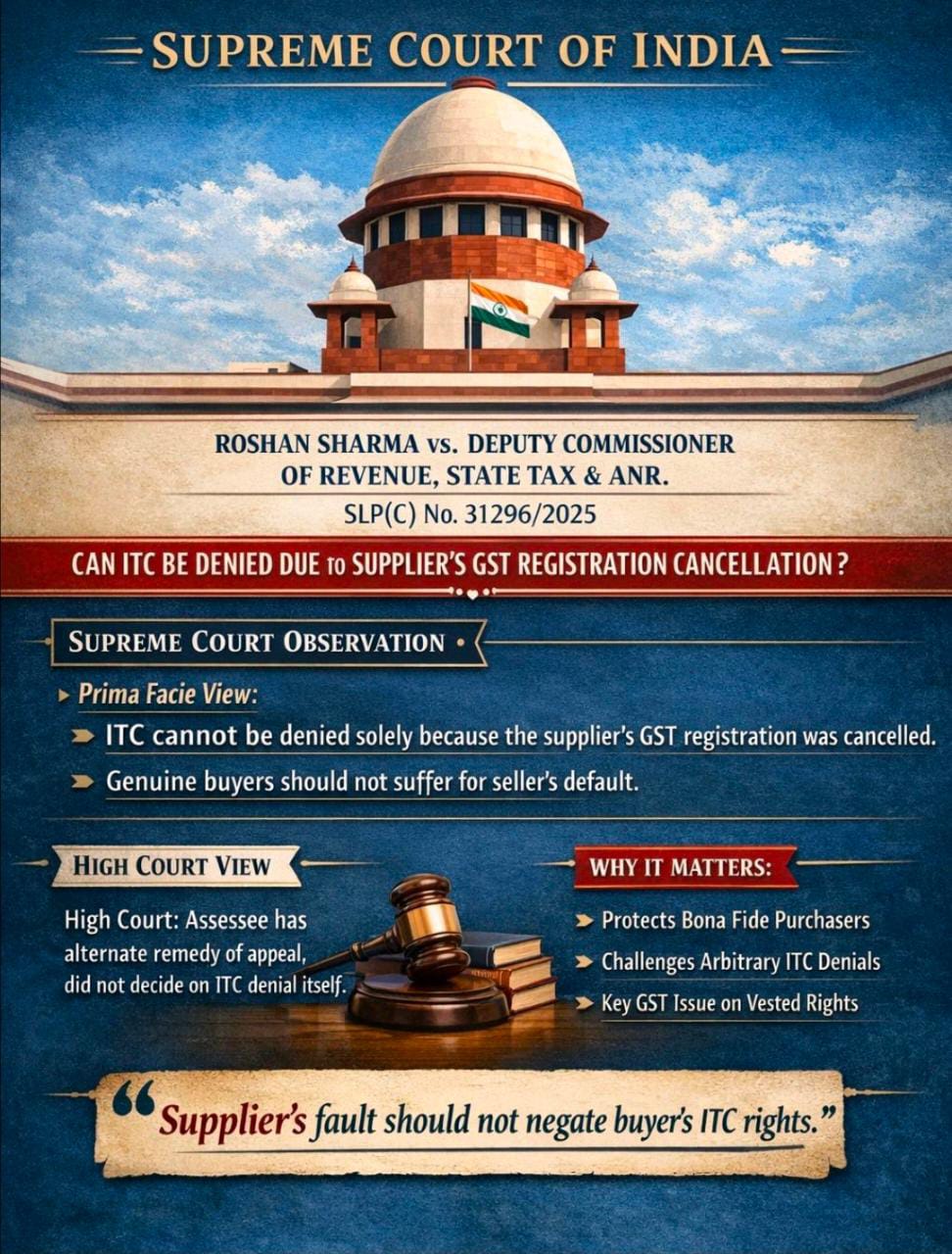
SUPREME COURT OF INDIA RECORD OF PROCEEDINGS

Petition for SpecialLeave to Appeal(C) No. 31296/2025

[Arising out of impugned final judgment and order dated 28-08-2025 in MAT No. 1212/2025 passed by the High Court at Calcutta]

ROSHAN SHARMA                                             Petitioner(s)

VERSUS

DEPUTY COMMISSIONER OF REVENUE, STATE TAX &ANR.                                             Respondent(s)

IA No. 276202/2025 - EXEMPTION FROM FILING C/C OF THE IMPUGNED JUDGMENT

Date : 10-11-2025 This matter was called on for hearingtoday.

CORAM :

HON'BLE MR. JUSTICE J.B. PARDIWALA HON'BLE MR. JUSTICE K.V. VISWANATHAN

For Petitioner(s) :Mr. Vinay Shraff,Adv.

Mr. Ravi Bharuka,AOR Mr. Dev Agarwal, Adv.

Mr. Shashank Chamoli,Adv.

For Respondent(s) :

UPON hearing the counsel the Court made the following

O R D E R

  1. Heard Mr. Vinay Shraff, the learned counsel appearing for the petitioner.
  2. Prima facie it appears that the High Court declined to grant any relief to the petitioner herein on the ground that the petitioner has an alternative efficacious remedy of going before the Commissioner, GST.
  3. The principal argument of the learned counsel is that ITC cannot be denied solely on the ground that the GST registration of the seller of goods has been cancelled. In other words, goods were purchased by the petitioner herein from a particular party and the GST registration of that party has stood cancelled. In such circumstances, his submission is that the ITC, insofar as the petitioner is concerned, could not have been denied.
  4. Issuenotice, returnable on 8.12.2025.
  5. One copy of the entire paper books shall be served to Ms. Madhumita Bhattacharya, the learned counsel, who ordinarily appears for the State of West Bengal.


(CHANDRESH)                                     (POOJA SHARMA)

ASTT. REGISTRAR-cum-PS                                                                                             COURT MASTER(NSH)

Read More
Image

INCOME TAX

  • 2026-01-15

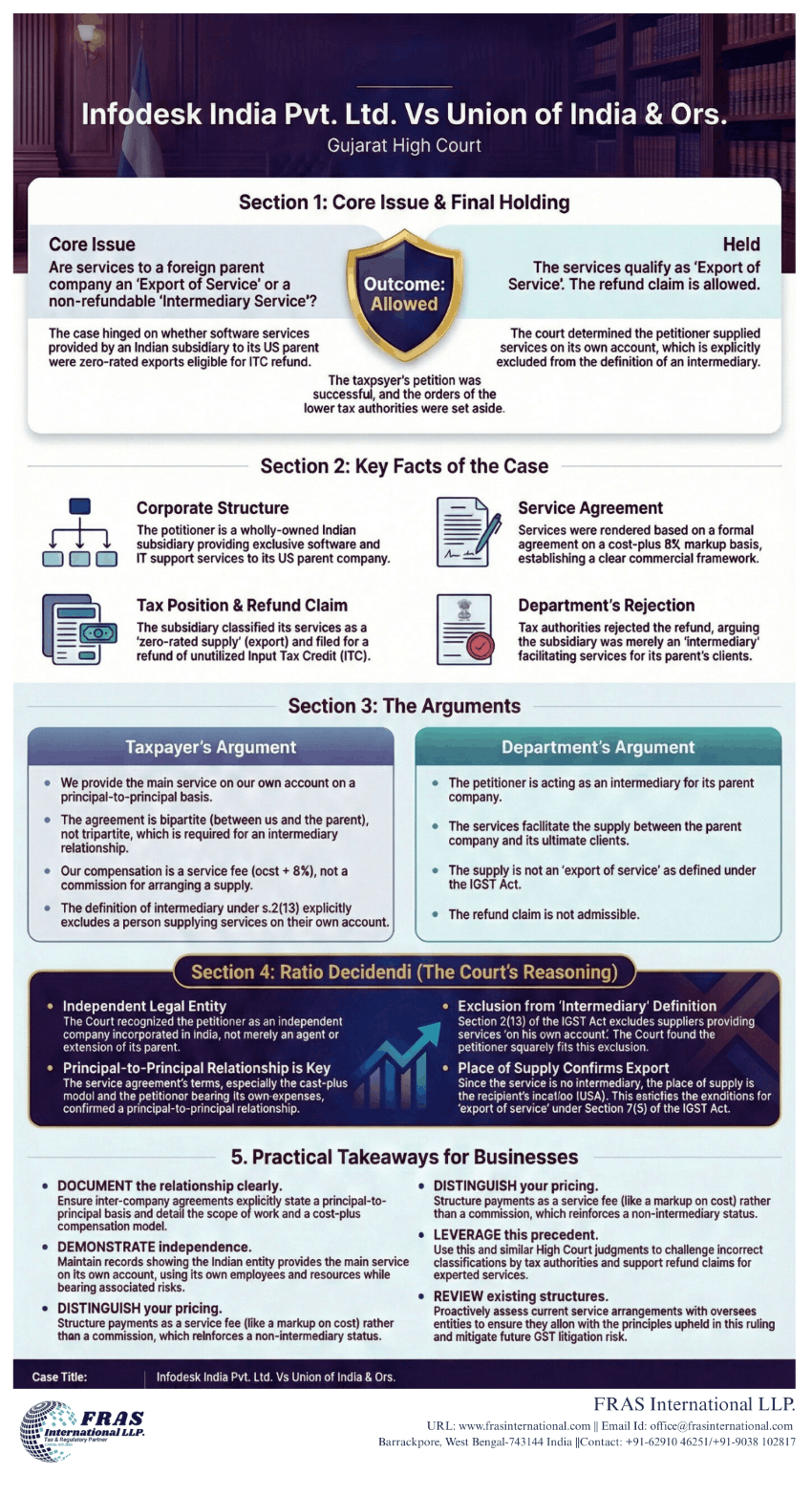
Taxpayer's Argument

  • We provide the main service on our own account on a principal-to-principal basis.
  • The agreement is bipartite (between us and the parent), not tripartite, which is required for an intermediary relationship.
  • Our compensation is a service fee (ocst8%), not a commission for arranging a supply.
  • The definition of intermediary under s.2(13) explicitly excludes a person supplying services on their own account.

Department's Argument

  • The petitioner is acting as an intermediary for its parent company.
  • The services facilitate the supply between the parent company and its ultimate clients.
  • The supply is not an 'export of service' as defined under the IGST Act.
  • The refund claim is not admissible
Read More
Image

RBI Update

  • 2026-02-03

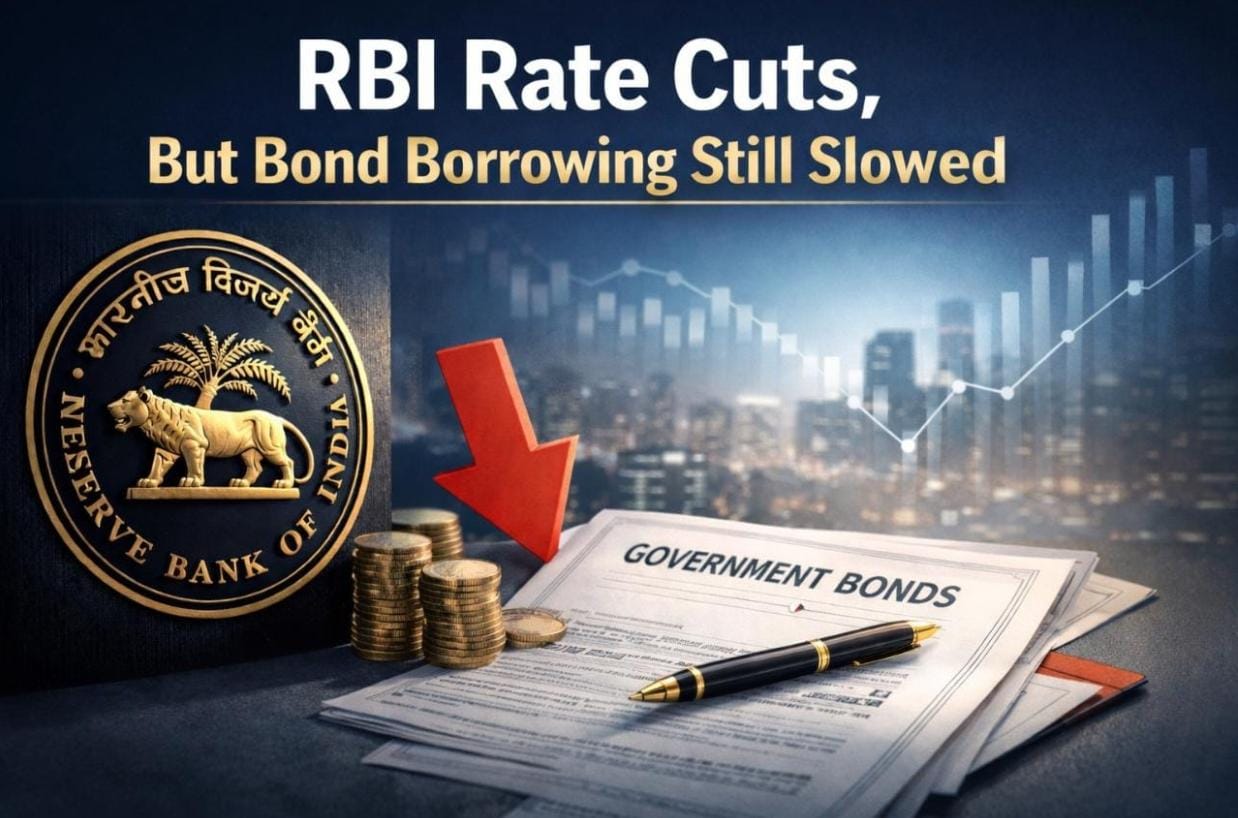
Why are Indian companies raising LESS money through corporate bonds this year?

First: What is a corporate bond?
When a company needs funds, it can either:
Take a loan from a bank, or
*Borrow directly from investors by issuing bonds

A corporate bond simply means:
> The company borrows money from investors, pays interest, and repays the amount later.

What did RBI do this year?
To support borrowing, RBI:
* Cut interest rates by 1.25%
* Injected additional liquidity into the banking system
* Relaxed certain lending norms for banks

In theory, this should have made bond borrowing cheaper.
But that did not fully happen.

What actually happened? 
* Corporate bond borrowing fell by around 6% compared to last year
* More companies accessed the bond market
* But they raised smaller amounts overall

Why borrowing looked strong early in the year
April–June period:
* Companies expected interest rates to fall further
* Bond yields were already softening

So many companies decided to borrow early, saying:

> “Let’s raise funds now before conditions change.”

Result:
* Very strong bond issuance in the first quarter
* Weak bond activity in later months

Global shocks changed the situation
After June, global uncertainty increased:
US imposed 50% tariffs on Indian goods
* Rupee weakened
* Foreign investors turned cautious

When global risk rises, market interest rates tend to move up.

Heavy government borrowing pushed yields higher
At the same time:
* Central government issued large volumes of bonds
* State governments also increased borrowing

Simple rule:
More bonds in the market = higher interest rates

So:
* Government bond yields rose
* Corporate bond yields also moved up

If RBI cut rates, why did bond interest rise?
This is the key point:
* RBI controls short-term interest rates
* Long-term rates are decided by the market

Markets reacted to:
* Heavy government borrowing
* Global uncertainty
* Weak rupee

Result:
* Long-term bond yields remained high
* Corporate bonds did not become cheap

Bank loans became cheaper than bonds
* Bank lending rates came down
* Corporate bond yields stayed elevated

So companies compared:
Bank loans = cheaper
Bonds = expensive

Decision was straightforward:
> Why issue bonds when bank loans are cheaper?

Many companies:
* Cancelled bond issuances
* Shifted borrowing to banks

Even banks issued fewer bonds
Banks themselves:
* Had sufficient deposits
* Received liquidity support from RBI
* Did not need to raise funds via bonds

Since banks are major bond issuers, their reduced participation further slowed the bond market.

Long-term borrowing became costly
Companies looking to borrow for:
* 10 years
* 15 years
* 20 years

Found that:
* Long-term bond yields were too high
* Cost of borrowing was unattractive
As a result, long-term bond issuance declined sharply.

Companies used alternative funding sources
Instead of bonds, companies preferred:
* Bank loans
* Foreign borrowings
* Syndicated loans

These options were:
* More flexible
* Sometimes cheaper
* Easier to manage

What could happen next Experts expect:
* Continued RBI liquidity support
* Stronger bank lending capacity
* Possible slowdown in government borrowing

This may gradually ease bond yields and revive corporate bond issuance.

Bottom Line
Despite RBI rate cuts, global uncertainty, heavy government borrowing and cheaper bank loans kept corporate bond yields high. As a result, companies reduced bond borrowing and shifted towards bank loans and alternative funding sources.

Read More

Image

INCOME TAX-UPDATE

  • 2026-02-03

📑 Budget Highlights – 2026

Income Tax Updates

  • Income Tax Act, 2025 effective from 1st April, 2026. Simplified Rules & Forms to be notified shortly.
  • Exemption: Interest awarded by Motor Accident Claims Tribunal to a natural person will be tax-free.
  • Small Taxpayer Scheme: Automated rule-based process to obtain lower or nil TDS certificate without filing an application.
  • Revised Return Filing: Extended up to 31 March following the tax year (original & belated returns). Nominal fee for revisions after 31 Dec: Rs 1,000 / Rs 5,000 depending on income.
  • TDS & Compliance Simplification* 
  • Manpower services now explicitly under TDS on contractor payments.
  • Depositories can accept Form 15G/15H from investors with holdings in multiple companies, and share directly with companies.
  • No TAN required for TDS on immovable property purchase from non-residents; PAN can be used like resident transactions.
  • Foreign Asset Declaration: Time-bound scheme for foreign assets & foreign income below a threshold.

Non-residents on Presumptive Taxation: 

  • Exempt from MAT (As per proposal).
  • Corporate & Accounting Changes ICDS Integration: Joint committee (MCA & CBDT) to merge ICDS into Ind AS; separate ICDS accounting removed from 2027–28.
  • Buyback Tax: Proceeds taxed as capital gains for all shareholders. Promoters’ effective tax: 22% (corporate), 30% (non-corporate).

Securities Transaction Tax (STT) Updates

  • Futures STT: Increased 0.02% → 0.05%.
  • Options Premium & Exercise STT: Increased to 0.15% (from 0.1% / 0.125%).

MAT (Minimum Alternate Tax) Updates

  • MAT Credit Set-Off: Allowed only under new tax regime, limited to ¼ of tax liability.
  • MAT Final Tax: Effective 1 April 2026, rate reduced from 15% → 14%. Existing MAT credits remain usable under new limits.

Employee Contributions

  • Deduction for employees’ contribution to PF, ESI, or similar funds allowed if employer deposits by income tax return filing date instead of statutory due date.

Key Takeaways

  • Simplified filing & compliance for individuals & small taxpayers.
  • Corporate & promoter taxation tightened (buybacks, MAT, STT).
  • Emphasis on integration of ICDS into Ind AS and digital compliance.
Read More